What MVHR System

we can recommend
depends on the type
and size of building

Comparison of Recommended MVHR Units

We work with a number of high quality MVHR systems. Almost all systems we use are accredited with Passivhaus certification, which is a seal of quality and good system configuration, not just for Passive Houses, but for all types of projects.

The aim is to provide a system, which is:

  • inaudible or almost silent,
  • is energy efficient,
  • retains its efficiency throughout the seasons, even in frosty weather
  • protects your indoor environment
  • is well controlled.

With the amount of different MVHR units available, it seems logical to compare their SAP ratings. Although this give a good indication into their performance, there are a number of important features that are normally not mentioned in brochures or websites. Please see what makes a good MVHR unit and how to avoid pitfalls.

Noise-Killer

Noise pollution is one of the biggest problems with domestic ventilation and often leads to systems notbeing used properly, with concurrent health risks.

How then can noise be tackled?

A) Choosing a quiet MVHR unit. The Zehnder ComfoAir Q range and Duco EnergyBox MVHR units are one of the most quiet ones on the market. In general Passive House certified units are often quieter than standard systems.

B) Adding powerful attenuators (silencers) to your supply and extract ductwork. These eat up any fan noise, so that it does not translate into your home. We use best performing Lindab LRCNA attenuators.

C) A well designed MVHR system with good ducting components and room terminals.

D) Regular houskeeping of the system: keeping filters and terminals clean.

MVHR attenuator
MVHR filtration levels

Filters that Protect You

Filters protect not only your home from dust and pollution, but also the heat exchanger and the ducts of the ventilation system. Unfortunately not all MVHR systems offer good filtration and some have very loosely fitting filters, which offer little protection.

We recommend to use F7 pollen filter (ISO ePM 2.5 60%) for the intake and G4 (ISO ePM coarse) for the extract. Filters should have a tight fit and be pleated (large surface area).

Following MVHR units take F7 pollen filters: Zehnder ComfoAir Q, Flex, 160, 180 and 200, DucoBox Energy Premium, Jablotron Futura L.

If you experience traffic smells, or smells from the neighbour’s wood stove, active charcoal filters will help. The ComfoAir Q range, the Jablotron Futura L and the bluMartin freeAir100 can take these directly as intake filter.

Volume-Flow Constant Operation

Gradually soiled filters and other factors will typically lead to reduced ventilation and drops in the heat recovery rate in real life.

Good systems have a volume flow constant operation, which keeps the original extract and supply air flow rates at the same level and in balance. The ComfoAir Q and ComfoAir Flex ranges, the ComfoAir 160 and 70 and ComfoSpot 50, the DucoBox Energy Premium, Jablotron Futura, the bluMartin free Air 100 are all volume-flow constant.

Therefore these system will always operate on peak performance all the time and provide the air supply and extract rates they were designed to do.

Volume-flow constant
ERV MVHR

Humidity Recovery - ERV or HRV?

Larger dwellings with few occupants can suffer from low humidity levels in winter. PAUL has invented a patented ERV heat exchanger, that recovers not only heat, but also about 70% of the moisture from the extract air back into the house. Don’t worry, no gases, viruses or smells transition. We would normally specify ERV systems for all larger dwellings, in order to provide the best climate possible.

Better MVHR systems offer an option bettwen the standard HRV and an ERV core: All Zehnder ComfoAir systems (apart from the ComfoAir 155 range), DucoBox Energy Premium, Jablotron Futura. The ComfoAir 70 and Spot 50 have only an ERV core.

Please note, that with ERV systems a defrost pre-heater is normally not necessary. There is also no need for a condensate connection.

Frost Protection

The higher the real efficiency of a system, the more vulnerable they are to frost. Most systems rely only on a frost protection mode, which dis-balances the supply and extract air flows when there is frost outside. This leads to increasingly reduced efficiencies, the more the outside temperatures drop. Thus ice cold air is introduced into the dwelling at the coldest time of the year, leading to cold drafts.

We always recommend using a defrost pre-heater, unless it is a very mild coastal climate, e.g. in the South of England. This defrost pre-heater will avoid any dis-balancing and keep the system operating on peak performance even at deepest winter temperatures. Following MVHR units can come with defrost pre-heater: Zehnder ComfoAir Q, ComfoAir Flex, ComfoAir 160, 180 and 200, Duco Box Energy Premium. Please ask specifically for this configuration unless you have an ERV core.

Defrost pre-heater
MVHR control

Controllability

When it comes to the control of MVHR systems, it is ‘horses for courses’, depending on the dwelling type and user expectations.

  • Fully automated systems with CO2 control: Jablotron Futura L, Duco Energy Box Premium, Zehnder ComfoAir Q, Flex, 160, 180 and 200, bluMartin freeAir 100
  • Two-zone controlled MVHR: Duco Energy Box Premium,
  • Room-by-room controlled MVHR with super boost: Jablotron Futura L
  • Smart app control: Jablotron Futura L, Zehnder ComfoAir Q, Flex, Duco Energy Box Premium
  • Monitoring app: Jablotron Futura L, bluMartin freeAir 100

Quality & Durability

We choose MVHR units according to their high quality engineering for lasting performance and durability.

In general, compared to standard MVHR units, MVHR units with Passive House cerification show to be of much better quality and have a well insulated housing.

All of our systems can be repaired, e.g fan bearings, apart from the Zehnder ComfoAir 155 range, which we cannot recommend out of that reason.

Passive House MVHR

Comparison of MVHR Systems

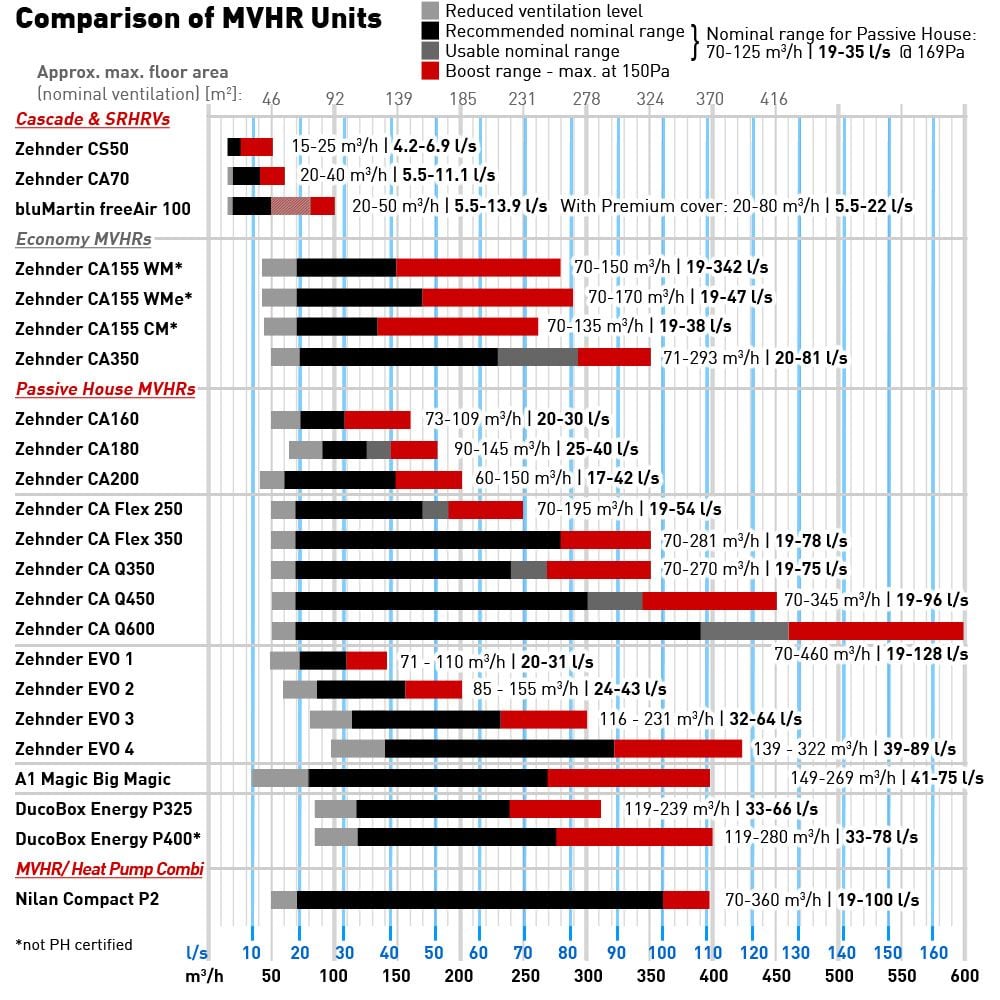
Please see below a comparison of various MVHR systems in terms of their air usable flow rates and their suitability for various sizes of dwellings.

Comparison of recommended MVHR systems


For the Zehnder product selector, please click here.

For the Nilan’s product comparison, please click here.

We have worked with a lot of different system, when either installing them, or when consulting on problems with them. You can see the quality (or the lack of it) when you open it and look at the level of insulation, thermal bridging, frost protection, the type of filters and other components.

Although we would like to see Passive House MVHR units for all properties, we are realistic enough that in many cases budgets will probably be too restricted for this. Our recommendation is, that if you need to save costs, save it on the MVHR unit and the room terminals, but not on the ducting. It is easier to exchange a MVHR unit in due course, but the ducting will probably be never exchanged for the life-span of the building.

When choosing the best system, please never forget proper noise attenuation. What is the point of a cheap MVHR system, if the users switch it off due to noise issues? There is a massive difference in break-out noise levels from different MVHR systems. When comparing noise levels, please bear in mind that each 3 dB(A) more is doubling the noise.

Further Information

Latest News

Dandashill Platform 3 Passive House Development

Passivhaus deemed to satisfy UK NZCBS

Passivhaus deemed to satisfy UK NZCBS The Passivhaus standard is now deemed to satisfy certain aspects of the UK Net Zero Carbon Buildings Standard (UK…

Glasgow Homebuilding & Renovation Show

Scottish Homebuilding & Renovating Show

Scottish Homebuilding & Renovating Show Glasgow PAUL Heat Recovery is exhibiting at the SEC in Glasgow on the 9th and 10th May 2026. Please visit…

Big Magic training

Big Magic Installer Training

Big Magic Installer Training May 2026 PAUL Heat Recovery hosts a product training event for the Big Magic MVHR system on Thursday 7th May 2026…

Launch of Zehnder Academy

Launch of the UK Zehnder Academy

Launch of the UK Zehnder Academy As Approved Zehnder Partner we were invited for the official launch of the UK Zehnder Academy in Camberley on…

Zehnder ComfoAir Q350, Q450, Q600

MVHR Unit

The ComfoAir Q is an all-rounder for many types of dwellings. This is a highly efficient and silent MVHR unit with app-control.

Zehnder ComfoAir Flex 250, 350

comfoair flex

The ComfoAir Flex range is powerful ceiling mounted MVHR unit. This is a highly efficient and silent MVHR unit with app-control.

Big Magic MVHR

Big Magic MVHR

The Big Magic MVHR is a unique demand-controlled MVHR system, which adjusts the airflow for each room individually. It can be combined with a air source heat pump for cooling and heating rooms as per demand.

Zehnder ComfoAir 200

Comfoair 200

The ComfoAir 200 is a versatile MVHR for smaller dwellings, which can be ceiling or wall mounted. A very well performing MVHR unit, but it will be replaced by the EVO MVHR in due course.

Zehnder ComfoAir 180

Comfoair 180

The ComfoAir 180 is ideal for apartments, which can be mounted in a kitchen cupboard or any other cupboard. As part of the system EPP twin ducting for the intake and exhaust, as well for supply and extract, make it easier to install.

Zehnder EVO

Zehnder EVO

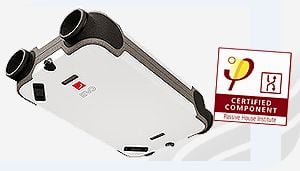
The new EVO range of ceiling or wall mounted MVHRs comes in 3 output sizes. Their unique sales advantage is their shallow depth and adjustable spigots and mounting brackets.

bluMartin freeAir 100

bluMartin freeAir 100

The freeAir 100 MVHR system is a fully demand-controlled system for smaller dwellings. It can be fully de-central or with extract ducting. As part of the cascade MVHR approach, it can be used with cascade fans, which connect habitable rooms into the system without ducting.

Zehnder CS50 and CA70

CS50 CA70

These small de-central MVHR systems are ideal for retrofitting. With Passivhaus certification they are good quality systems.

Zehnder ComfoAir 155

Comfoair 155

The ComfoAir 155 WM, Wme or CM is Zehnder’s ecomony MVHR range, formerly known as Greenwood Vireo.

Nilan Comfort 250 Top

Nilan Comfort 250 Top

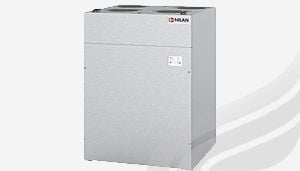
This MVHR unit is made for development projects

Combined MVHR, Heating, Cooling & DHW

compact p

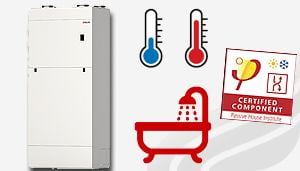
Combined domestic systems save space and installtion time on site. Nilan’s Compact P, S and now P2 are the best fit for smaller, energy efficient developments up to 140 m2.

Heating & Cooling with MVHR

heating & cooling with MVHR

More information on heating and cooling in combination with MVHR systems.

What about PAUL?

PAUL MVHR

The brand ‘PAUL’, as part of the Zehnder company, has now been incoporated into their product portfolio. The once very popular PAUL novus 300 MVHR with its superior Passivhaus data has been replaced by the ComfoAir Q350 MVHR unit.