MVHR and MEV Ducting Components
The choice of a correct system proves often difficult as a variety of cheaper or more expensive products are on the market.
We believe ducting systems should be:
In our ambition to offer non-compromise ducting systems, we have narrowed our portfolio to those products that perform well. We have tried and tested a large number of ducting systems and components and found many poorly performing.
Most of the ducting, once installed, will most probably not be changed for the life-span of the building. It does not make sense to install a product that will result in 2-3 times more energy use and noise, cannot be cleaned or falls apart over time.


Following the standard specification in Europe, we mostly use a radial ducting system. It is easy to install, almost as efficient as metal ducting, but not as expensive and can be easily cleaned.
Such ducting is inherently cross-talk attenuated, needs no tapes or mastic and has very little risk of leakage due to few connection points.
One of the most critical parts of the system is fan noise attenuation. Attenuators, or commonly called silencers make all the difference from a noisy system that annoys users to a quiet ones, that they love.
We use Lindab’s best attenuator, the LRCNA, to have best possible results. For the supply ducting we use normally the 1000mm version, for the extract the 500mm long LRCNA. They can sit vertically on top of the MVHR unit or be horizontally installed in the ceiling.


The intake and exhaust ducting carry cold air in the cold seasons and need to be well insulated, to avoid condensation, water damage and minimise heat loss.
We find the usually used insulated flexible foil ducting has a risk of condensation, if not 100% safely installed, and therefore normally don’t use it.
We either use pre-insulated EPP ducting, such as Zehnder’s ComfoPipe Plus (43mm insulation) or 25/ 50mm Armalfex insulation on top of metal ducting. It is a closed cell insulant, that cannot attract condensation.
Room terminals are the one component that is visible in your home. These therefore need to be discreet, quiet, and well performing, whilst avoiding drafts.
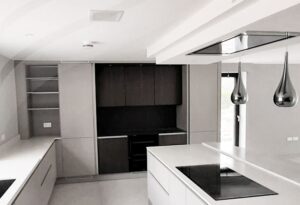
Lindab’s designer valve Airy is our preferred choice (picture top), as it is one of the quietest and nicest room terminals you can get.
Kitchen extract terminals should always be filtered, to avoid grease deposits in your ductwork.


With limited space on external walls for the air intake and exhaust, we prefer directional combi-grilles. These keep the cross-contamination to a minimum.
They come in either stainless steel or are powder coatedin white or black. On request we can poweder coat them in any RAL colour.

Good MVHR filters have proven to make a massive difference to occupant’s health and wellbeing.
Instead of the standard G3 or G4 dust filters, which filter out only coarse dust, we offer pollen filters, which filter fine dust (down to 1/1000th of a millimeter particle size = 1 micron) from the incoming air:pollen, mould spores, bacteria, allergens.
We also offer active charcoal filters, which bind combustion fumes, e.g. from wood stoves or traffic.


If there is anything else you need, please let us know. We are happy to help and accommodate your special ducting needs:
Passivhaus deemed to satisfy UK NZCBS The Passivhaus standard is now deemed to satisfy certain aspects of the UK Net Zero Carbon Buildings Standard (UK…
Scottish Homebuilding & Renovating Show Glasgow PAUL Heat Recovery is exhibiting at the SEC in Glasgow on the 9th and 10th May 2026. Please visit…
Big Magic Installer Training May 2026 PAUL Heat Recovery hosts a product training event for the Big Magic MVHR system on Thursday 7th May 2026…
Launch of the UK Zehnder Academy As Approved Zehnder Partner we were invited for the official launch of the UK Zehnder Academy in Camberley on…