Good Filtration

can make a big difference
to your health & wellbeing

MVHR Filter Maintenance

MVHR Filters

In order to maintain the proper function of a ventilation system, it is important to check and service all of the filters regularly. Some filters can be cleaned with a vacuum cleaner, especially when it is only dust or insects that have been captured. Cellulose based filters should not be washed.

It is recommended to check filters every 3-6 months, depending on the use of the system, the environmental pollution and the dust load. When a filter has got a continuous layer of dust, it is high time to get them cleaned or changed. Once a year all filters should be replaced, in order to avoid any growth on the filter medium. Keep in mind, that the dust that is trapped in the filters, is dust that did not enter your dwelling.

MVHR Filter
PH MVHR: Testimonial of Lung Disease Sufferer

Health Benefits of Pollen Filters

did you know that Passive House MVHR Systems with pollen filtes can have substantial benefits in terms of the health and wellbeing of the occupants?

If you compare MVHR systems, check if they can take F7 (pollen) filters.

Unfortunately most cheaper systems only take coarse G3 or G4 filters, that do not filter out micro dust particles.

One of our customers (Bart from Cambridge) wrote to us after he changed his MVHR intake filter to F7 grade:

“Since installing the F7 filters my wife could stop using her anti-allergen medication, which is a big win!”

What Is It Filtering?

These are the typical airborne particles in relation to MVHR filtration levels.

Filtering the intake air serves primarily the purpose of keeping the duct work clean. Additionally good filters also improve the indoor air quality, which studies of dwellings with MVHR have shown (Schneiders 1994, Feist 1995, Flueckinger 1997). These proved that good filters (e.g. F7 grade) on the air intake substantially reduced the concentration of bacteria and spores in the intake air and the room air, compared to the outside air. In summer when windows were opened more frequently, the internal room concentrations of spores and especially bacteria increased again, partially above the external air concentrations, as these increase with the presence of occupants, pets, plants, foods and others.

MVHR filtration levels
Filter categories

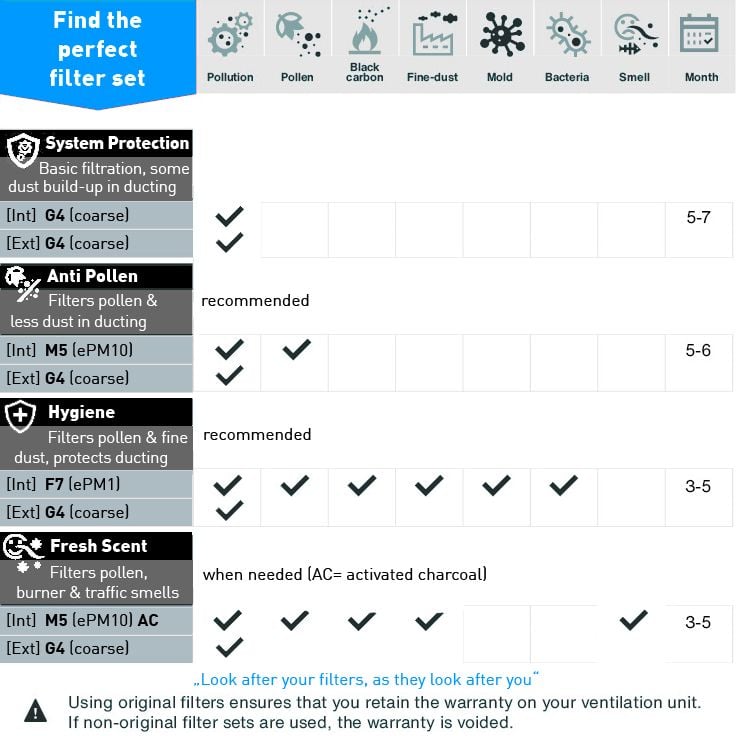
Typical Filter Types for MVHR

  • Minimal standard filters (G3): These are the current filters in most UK made systems, which can cause smaller dust particles to pass through and subsequently soil the heat exchanger and ductwork over time and are therefore not recommended.
  • System protection filters (G4): for minimal protection of the heat exchanger and ductwork from coarse dust.
  • Anti-pollen filters (M5): These keep smaller particles, like pollen out. We would rather recommend Hygiene (F7) filters, as these filter amore smaller particles out.
  • Fresh-scent filters (AC): These filter out organic smells, such as traffic fumes, combustion fumes and rural smells.
  • Hygiene filters (F7): These are the filters, we would always recommend for the air intake. Most UK made system are not compatible for these type of filters.
  • Max Hygiene filters (F9): These can be used when there is a need for high grade filtration.
  • HEPA filters (H12): These are not compatible for domestic ventilation systems.

Activated Carbon Filters

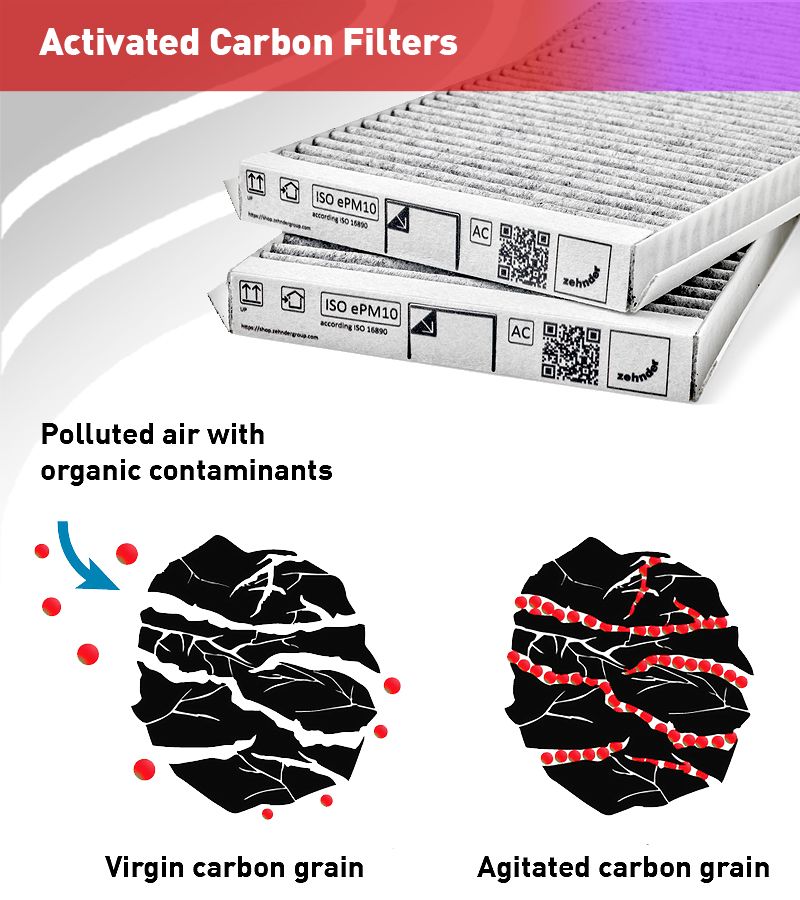
When traffic fumes or smells from a neighboring wood stove are being drawn into an MVHR system, active charcoal filters can help. These bind the organic contaminants by adsorbtion.

Some MVHR systems, as the Zehnder ComfoAir Q unit, can take an active carbon filter into the MVHR unit (instead of the F7 intake filter). Otherwise a filter box can be added either between MVHR unit and the supply duct work, e.g. manifold, so that the MVHR intake filter serves as a pre-filter.

If there is no space in the supply leg, it could also sit on the intake duct run from the outside. In this case, care should be taken that the filter box is insulated, to prevent condensation and minimize heat losses.

If a filter box is added to a non volume-flow constant MVHR system (most cheaper MVHRs), then the MVHR needs to be re-commissioned, as the additional filter will reduce and dis-balance the system air flow.

Activated Carbon Filters
MVHR NOx Filter

NOx Filtration

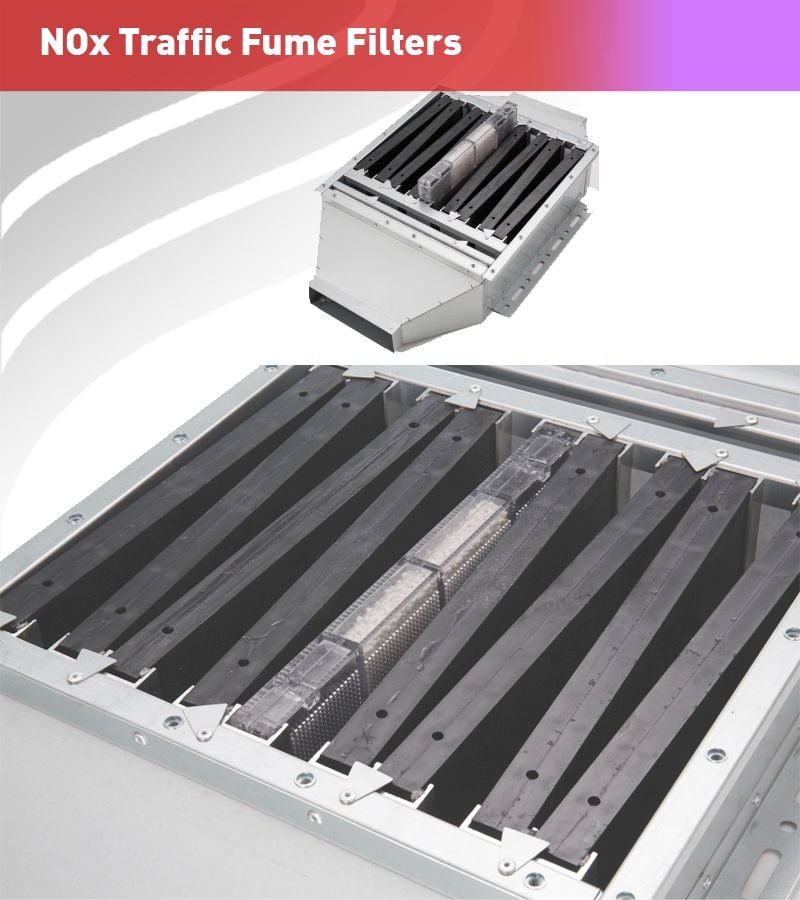
Activated Carbon filters can provide basic NOx removal, but more specialized filters have either a special coating or carbon fibres.

Type NOx Removal
Standard AC Filter Moderate efficiency
Impregnated AC Filter High efficiency
Fibre AC Filter Very High efficiency

Impregnated activated carbon uses chemicals like potassium hydroxide to adsorb more NOx. They can also adsorb nitric oxide and reduce nitrogen dioxide.  (Source: tankechemical.com)

Particle Sizes

When dealing with airborne particles, these are minute, too small to see with the naked eye.

The size is typically measured in microns, which is 1/1000th of a millimeter.

The smaller the particles, the deeper they penetrate into our respiratory tract and the deeper they go, the more harm they can cause.

Particle sizes
virus particle sizes

Filtration of Viruses

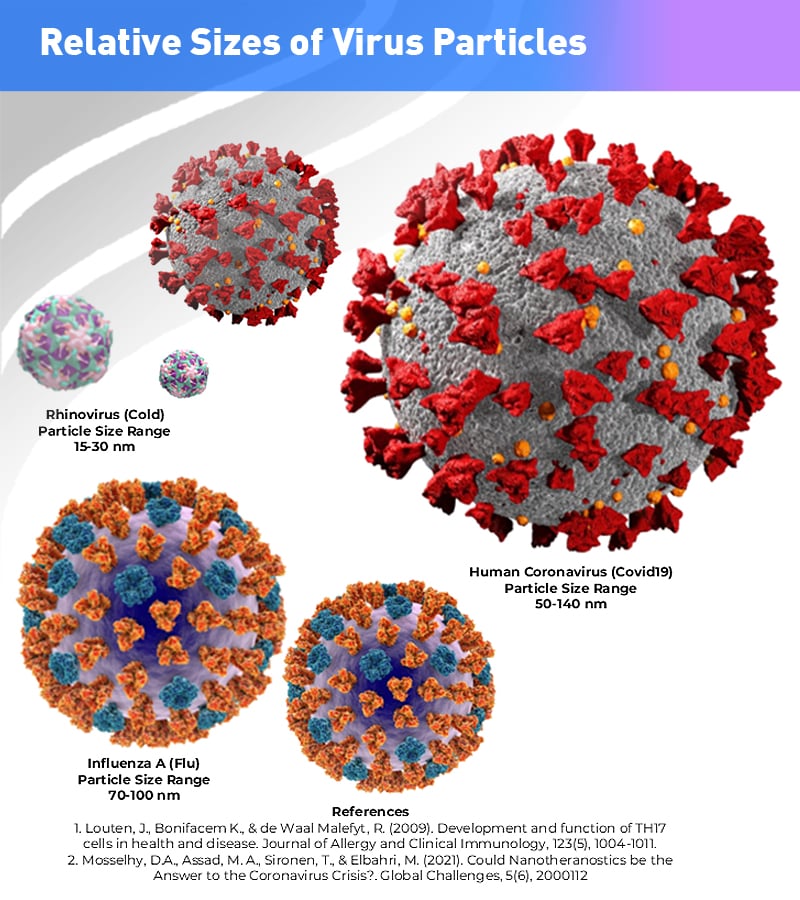
Corona viruses are around 0.1 microns in size, and at that size no standard filter can help. However, viruses are normally bonded to something larger, e.g. droplets. “There is never a naked virus floating in the air or released by people,” said Linsey Marr, a professor of civil and environmental engineering at Virginia Tech who specializes in airborne transmission of viruses. The virus attaches to water droplets or aerosols (i.e. really small droplets) that are generated by breathing, talking, coughing, etc. These consist of water, mucus protein and other biological material and are all larger than 1 micron. “Breathing and talking generate particles around 1 micron in size.”

F7 filters filter out at least 65% of 1 micron sized particles.

MVHR systems filter out most of the air pollution, as well as air borne bacteria and viruses in aerosols through the constant air exchange and extraction.

In general the risk of bringing in bacteria and viruses from the outside through an MVHR system is negligable.

What filters should be used for a MVHR system?

  1. Intake (within the MVHR unit): G4 filters or M5/ F5 filters are supplied as standard, but it is generally recommended to use a finer filter of F7 grade, also called pollen filter. These help to keep the supply ductwork clean, as they filter finer dust and particles and bacteria and spores out of the incoming air. PAUL now offeres new F7 filters, which have better air flow properties and can be more easily cleaned.
  2. Extract (within the MVHR unit): Typically a coarse dust filter of G4 grade is being used.
  3. For areas of high traffic pollution, we can provide active charcoal filters for the supply air, that bind dangerous NOx gases.
  4. Kitchen extract (in the room extract point): Typically a dust & grease filter of G3 grade is being used.

Most of our modern systems are volume flow constant, which means that they maintain the same airflow and keep balanced, even when filters start to clog up. When the filters are very soiled, the system will become louder, as the fans have to compensate for the increased resistance. Keeping the filters clean will help to keep the system silent and to maintain a low energy usage.

Zehnder original filters and the the new ISO 16890 standard

Filter grades

Filters are classified in different grades, which capture particles of different sizes. Whereas the old standard EN 779 tests arrestance of only one particulate size, the new standard ISO 16890 determines arrestance over a spectrum of particulate sizes.

Filter classification according to ISO 16890:

Class Minimum efficiency at
the range of particle sizes
Typical particulate matter
of that size
Reach into the human body
ISO coarse average less than 50%
of 0.3 – 10 μm
Sand, hair, coarse particles
ISO ePM10 average more than 50%
of 0.3 – 10 μm
Pollen, fine dust reaches the upper respiratory system
ISO ePM2.5 minimum 50%
of 0.3 – 2.5 μm
Bacteria, fungal and mould spores, pollen reaches the lower respiratory system (lungs)
ISO ePM1 minimum 50%
of 0.3 – 1 μm
Viruses, combustion particles, tobacco smoke, nano particles reaches the pulmonary alveoli and bloodstream

How does the old standard of EN779 relate to the new ISO 16890:

Class ISO ePM1 ISO ePM2.5 ISO ePM10 ISO coarse
G3 >80%
G4 >90%
M5 >50%
F7 50-65% 65-80% >85%

Typical Particle Sizes

Source: Camfil

 Type of pollutant: Particle size:
Visible to the eye >20µm
Particles entering the lung 0.05-5µm
Human hair 20-100µm
Normal dust 20-200µm
Pollen 10-100µm
Plant/ fungal spores 10-35µm
Bacteria 0.35-10µm
Viruses 0.002-0.06µm
Soot 1-100µm
Oil smoke 0.035-1µm
Tobacco smoke 0.01-1µm
Smog <2µm
Cement dust 3.5-100µm
Sinking dust 1-100µm
Suspended atmospheric dust <1µm


Further Information

Latest News

Dandashill Platform 3 Passive House Development

Passivhaus deemed to satisfy UK NZCBS

Passivhaus deemed to satisfy UK NZCBS The Passivhaus standard is now deemed to satisfy certain aspects of the UK Net Zero Carbon Buildings Standard (UK…

Glasgow Homebuilding & Renovation Show

Scottish Homebuilding & Renovating Show

Scottish Homebuilding & Renovating Show Glasgow PAUL Heat Recovery is exhibiting at the SEC in Glasgow on the 9th and 10th May 2026. Please visit…

Big Magic training

Big Magic Installer Training

Big Magic Installer Training May 2026 PAUL Heat Recovery hosts a product training event for the Big Magic MVHR system on Thursday 7th May 2026…

Launch of Zehnder Academy

Launch of the UK Zehnder Academy

Launch of the UK Zehnder Academy As Approved Zehnder Partner we were invited for the official launch of the UK Zehnder Academy in Camberley on…

MVHR Ducting Components

ducting

Info on Indoor Air Quality

iaq

MVHR Filter Shop

mvhr filters