Keeping Cool

Overheating protection by design
from shading,
purge ventilation
to active cooling

Overheating Protection

In recent years we were approached more often to provide cooling solutions to homes. Modern homes often feature large glazing, and in conjunction with light-weight building structures – without thermal mass – these can pose a high risk of overheating. This can happen even in Scotland, as the overheating risk is less dependent on external temperatures than on the amount of solar gains.

An overheating risk analysis should be part of every design of dwellings right from the start. It is not good practice to ignore the issue and leave it up to the M&E team. Mechanical cooling is fairly power hungry and expensive to run and should be avoided if possible.

Following cascade of mitigating factors should be considered:

1) Structural shading: e.g. overhangs, brisolei, shutters

2) Other forms of shading: e.g. greenery, trees, blinds

3) Optimizing the g-value of glazing: This way solar gains through windows can be reduced.

4) MVHR system (well insulated and high performing): If solar gains are mitigated, the MVHR will help keeping the dwelling cooler by deflecting the heat of the incoming air to the outside and recovering cold to the inside.

5) Purge ventilation by cross ventilation: remember that with MVHR systems, windows can still be opened.

6) Mechanical purge ventilation: 4-10 air exchanges will help getting rid of solar gains.

7) Thermal mass: e.g. exposed stone or concrete. In warmer climates this will only work in conjunction with shading.

8) Thermal absorption: e.g. phase changing materials.

9) Mechanical ventilation with cooling: e.g. MVHR with mechanical cooling or evaporation/ adiabatic cooling. Please note that this will only provide sufficient cooling in conjunction with shading.

10) Air conditioning as last resort.

Overheating can also be caused or contributed by un-insulated heating or hot water pipework within the thermal envelope. Special attention should be paid to constant operating pipes, e.g. instant hot water loops. We had one case of hot water pipes from an AGA stove that emitted so much heat that the dwelling was overheating in winter.

Also heat radiation into service zones where MVHR ducting is installed can add to the overheating risk.

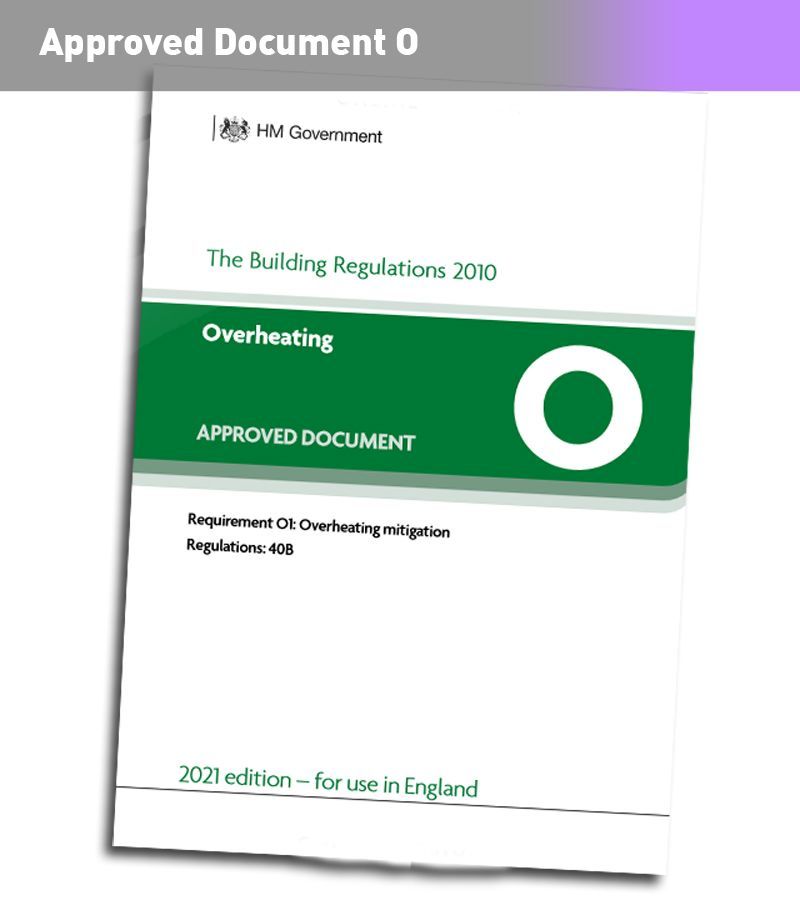
Approved Document O

The Approvd Document O aims to mitigate the risk of overheating.

This part of the English Building Regulations as introduced in June 2022. It is not applicable in Scotland.

It first sets out a simplified method to demonstrate compliance with Part O. This can be applied to both moderate and high-risk locations. The risk category is determined by the location of the dwelling:

  • Moderate risk – England, excluding high risk parts of London
  • High risk – Urban and some suburban parts of London.

There are two ways to meet compliance with the Approved Document O:

  • Simplified method
  • TM59 Dynamic Thermal Modelling

Approved Document O

The Simplified Method to Prove Compliance with Approved Document O

The simplified method only looks at the total floor area, glazing areas and free areas of the glazing. Any external shading or mechanical ventilation is not included in the simplified method.

The calculations are also categorised by whether a building is cross-ventilated (has openings on opposite facades) or not. The simplified method is not suitable for buildings with more than one residential unit which use a communal heating or hot water system with significant amounts of horizontal heating or hot water distribution pipework.

Limiting Solar Gains: To comply with Part O you will need to limit solar gains to the property by remaining within the maximum area of glazing allowance. This is dependent on a variety of factors including; orientation, the location, and whether the dwelling is cross-ventilated.

In addition to following maximum glazing areas, residential buildings in high-risk locations should provide shading for glazed areas between compass points north-east and north-west via the south. Shading should be provided by one of the following means:

  • External shutters with means of ventilation
  • Glazing with a maximum g-value of 0.4 and a minimum light transmittance of 0.7
  • Overhangs with 50 degrees altitude cut-off on due south-facing facades only.

Removing Excess Heat: To comply with Part O you will also need to ensure that openings are designed to achieve the minimum free areas.

Free area is defined as the geometric open area of a ventilation opening. This area assumes that a clear, sharp-edged orifice that would have a coefficient discharge. The minimum free area allowance is based on risk category, and whether the building is cross-ventilated.

Security

When determining the free area available for ventilation during sleeping hours, only the proportion of openings can be opened securely should be considered to provide useful ventilation. This particularly applied in the following locations, where openings may be vulnerable to intrusion by a casual or opportunistic burglar:

  • Ground floor bedrooms
  • Easily accessible bedrooms

Open windows or doors can be made secure by using any of the following:

  • Fixed or lockable louvred shutters
  • Fixed or lockable grilles or railings

If your dwelling doesn’t meet compliance under the simplified method, either the glazing design can be amended or a TM59 calculation will be needed.

TM 59 Thermal Modelling

If your building fails to meet Part O compliance using the simplified method, dynamic thermal modelling is required.

A TM59 assessment is a more detailed calculation that takes more parameters into consideration e.g., fabric specification of the dwelling. It also looks at any external shading or mechanical ventilation that is part of the building design. If needed, these measures can be implemented into the design to meet compliance as mitigation measures.

Dynamic thermal modelling is able to offer the designer additional flexibility over the simplified method by factoring in additional mitigation measures such as solar shading and MVHR anc cooling systems.

To demonstrate compliance using dynamic thermal modelling, the CIBSEs TM59 methodology should be followed in accordance with the Part O mitigation hierarchy.

Summer Bypass Function of MVHR Systems

Most of our MVHR units have an in-built summer bypass function:

The bypass opens when the extract air temperature exceeds a certain limit.

The more the fan speed, the more effective is the bypass ventilation. However the cooling effect is limited, but also low-cost, as it is passive. In contrast air conditioning can be much more powerful, but also uses a lot of electricity (it needs about 3-4 times more energy to actively cool a space than to heat it).

Solar gains can be very powerful and can bring a few kW of heat into your building, especially if there is large panels of glazing. The bypass function is not designed to counteract all solar gains, but to counteract these, as much as possible, in a passive way.


Unlike air conditioning, dwellings with MVHR do not need to have their windows kept closed, in order for the system to work. So feel free to open windows and doors, if you like. However if you don’t want to open them, the MVHR system is designed to provide good air quality without opening of windows and infiltration vents.

The bypass opens and closes usually fully automated, according to the extract air temperature readings. Ideally it is a 100% bypass, without air leakage.

With the newer PAUL units, you can see if the bypass is open or closed in the information menu/ current device status.

You can change the bypass comfort temperature for the PAUL units. The temperature is measured in the MVHR unit (the combined extract air, which reflects the average temperature in the dwelling). However the threshold temperature cannot be adjusted to less than 20 degrees C, in order to prevent unintentional conflicts with the heating. The bypass does not open, if the outside air temperatures are below 13 degrees, in order to prevent condensation on the supply ducting within the house. Your technician can lower this temperature to 12 degrees.

Bypass explode

Further Information

Latest News

Dandashill Platform 3 Passive House Development

Passivhaus deemed to satisfy UK NZCBS

Passivhaus deemed to satisfy UK NZCBS The Passivhaus standard is now deemed to satisfy certain aspects of the UK Net Zero Carbon Buildings Standard (UK…

Glasgow Homebuilding & Renovation Show

Scottish Homebuilding & Renovating Show

Scottish Homebuilding & Renovating Show Glasgow PAUL Heat Recovery is exhibiting at the SEC in Glasgow on the 9th and 10th May 2026. Please visit…

Big Magic training

Big Magic Installer Training

Big Magic Installer Training May 2026 PAUL Heat Recovery hosts a product training event for the Big Magic MVHR system on Thursday 7th May 2026…

Launch of Zehnder Academy

Launch of the UK Zehnder Academy

Launch of the UK Zehnder Academy As Approved Zehnder Partner we were invited for the official launch of the UK Zehnder Academy in Camberley on…

Heating & Cooling with MVHR

heating & cooling with MVHR

Combining an MVHR system with active heating or cooling is possible, but limited in its potential. We have been involved in many such projects and learned how to get it right.

CoolMagic ASHP

cool magic

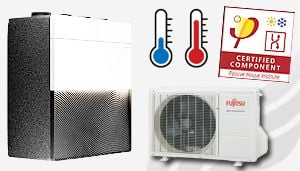
The Jablotron CoolBreeze is a reversible Air Source Heat Pump with MVHR heat exchanger. It is fully integrated into the controls of the Jablotron Futura L MVHR system.

ComfoClime

Comfoclime

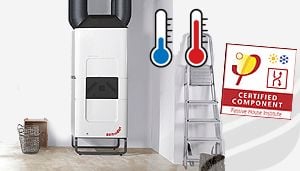
The Zehnder ComfoClime heating and cooling module is a bolt-on to the Zehnder ComfoAir Q range of MVHRs. The controls are all integrated into the MVHR system.

ComfoPost

comfopost

The Zehnder ComfoPost heating and cooling battery is part of the ComfoWell family and can be used for any high-quality MVHR system. It does not come with a reversible heat pump and controls.

Nilan Compact P/ P2

compact p

The Nilan Compact P, P2 and S are all-in-one service units, combining MVHR with an air source heat pump. They provide DHW, passive and active heat recovery ventilation and cooling through the supply air.

Nilan Combi

Nilan Combi 400 Top

The Nilan Combi 302 or 400 is an MVHR system with active heating and cooling function with heat pump technology.